- Solution Architecture
- learning-log
- problem-solving
- solution-design
- tech-market
- cloud-engineering
- business-acumen
Why People Should Learn Architecture Framework Thinking in the AI Era
AI made building cheap; judging what was built is now the scarce skill. Why architecture framework thinking matters, and why ops people already have it.
What changes when everyone can build?
Building got cheap. Judging what was built did not. Today almost anyone can describe a product to an AI coding agent and get working code back in an afternoon. What the agent doesn't tell you is whether that product is any good.
Four questions decide that, and none of them is answered by the code compiling:
- Is it precise? Does it do exactly what was asked, without hallucinated logic, invented fields or silent assumptions?
- Does it solve the problem? Not the problem as it was typed into a prompt, but the one the business actually has.
- Will it scale without leaving debt behind? Or will the next feature need a rewrite?
- Was the effort spent well? Every round of vibe-coding back-and-forth costs tokens and time. A vague brief can burn more of both than the build itself.
Answering those questions before and during the build is what I mean by architecture framework thinking.
What is architecture framework thinking?
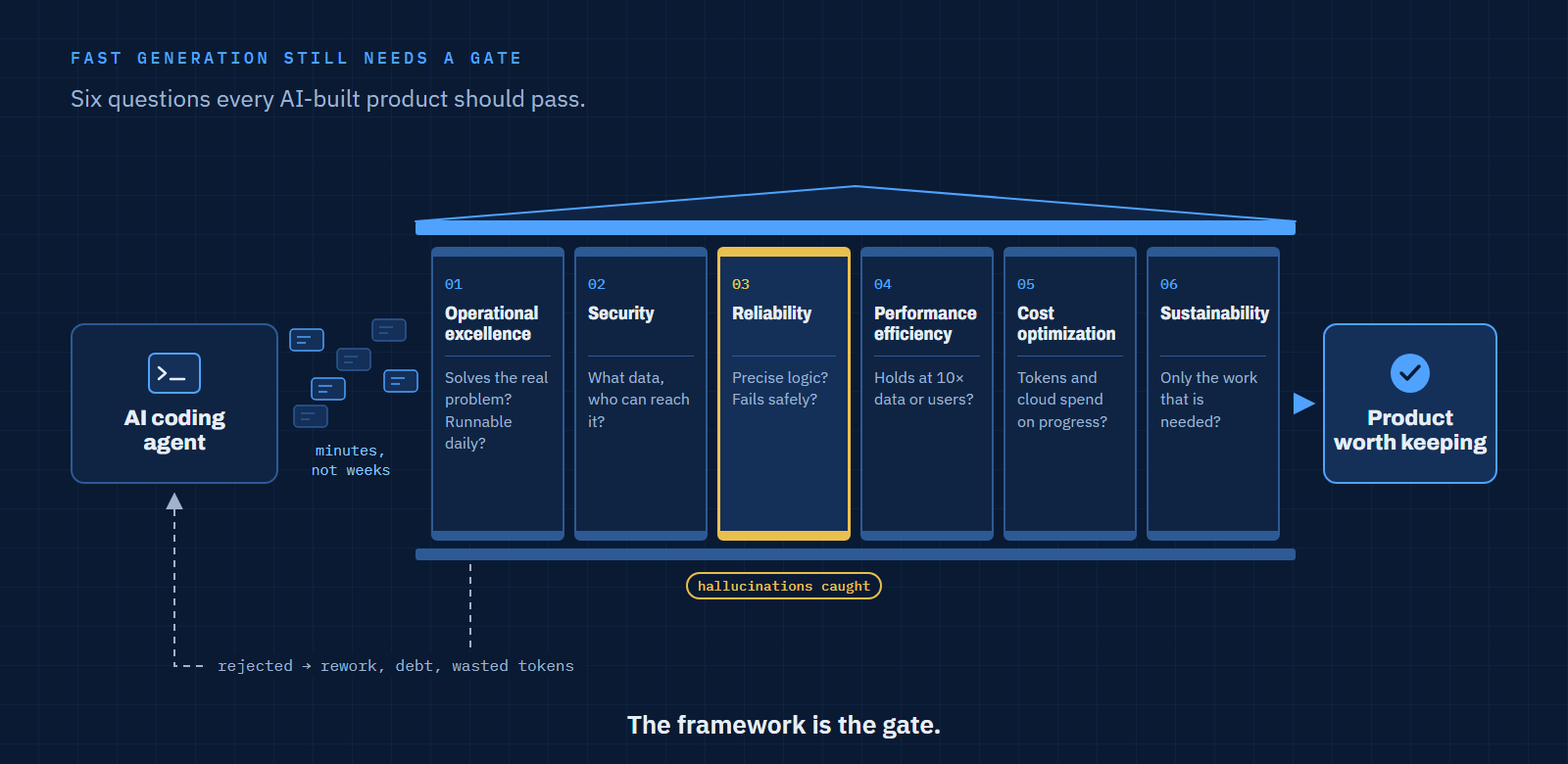
It is the habit of checking a solution against a fixed set of questions, every time, instead of trusting that it looks right. Cloud providers publish such frameworks; the AWS Well-Architected Framework, for example, reviews every workload against six pillars. The value isn't in the diagrams. It is in asking the same hard questions consistently.
Those pillars map almost one to one onto what goes wrong with AI-built products:
| Pillar | The question for an AI-built product | What happens without it |
|---|---|---|
| Operational excellence | Does it solve the real problem, and can someone run it every day? | A demo that works once and nobody owns |
| Security | What data does it touch, and who can reach it? | Secrets in code, open endpoints, no access rules |
| Reliability | Is the logic precise, and does it fail safely? | Hallucinated rules that pass a happy-path test |
| Performance efficiency | Will it hold up at ten times the data or users? | A rewrite at the first real growth spurt |
| Cost optimization | Are the cloud bill and the AI token budget spent on progress? | Endless prompt loops and oversized resources |
| Sustainability | Is it doing only the work that is needed? | Pipelines recomputing everything, every run |
 Open full size
None of these questions requires writing code. All of them require knowing what good looks like.
Why doesn't AI replace that judgment?
Because two things don't come from a prompt.
The first is intuition built from accumulated experience: the sense that a result feels right or feels off before you can prove it. In this series, that sense did most of the work. A team's handling time looked too good to be true, and it was. A building looked perfect for a smart locker on every metric, and nobody used it. In both cases the data was clean and the conclusion was wrong. Someone had to notice.
The second is a logical framework for qualitative accuracy: a way to decide whether something is correct when there is no test that says so. An AI agent can confirm that a query runs. It can't confirm that "a booking" in that query means the same thing as "a booking" in the finance report, or that the area it groups by matches how the business is organised.
AI is very good at producing an answer. Deciding whether it is the right answer is still a human job, and it is the part that is getting more valuable, not less.
Why does AI help senior engineers more than juniors?
AI already writes accurate code, reads documentation on GitHub, debugs, reads error logs and points at the step where a pipeline broke. That makes engineering work easier, though not effortless.
But the benefit is uneven. A senior or lead engineer who already thought precisely before AI uses it as a multiplier: they know what to ask for, they spot a wrong answer quickly, and they can automate whole processes because they understand the system. A junior engineer with little experience gets code faster, but not judgement faster. They can't yet tell which of the agent's confident answers is wrong.
So the multiplier is judgement. AI amplifies whoever already has it. That is why I chose to grow toward cloud data engineering and solution architecture rather than toward writing more code by hand: the scarce skill is deciding what should be built and how the parts connect.
Why should a hiring manager look at people from operations?
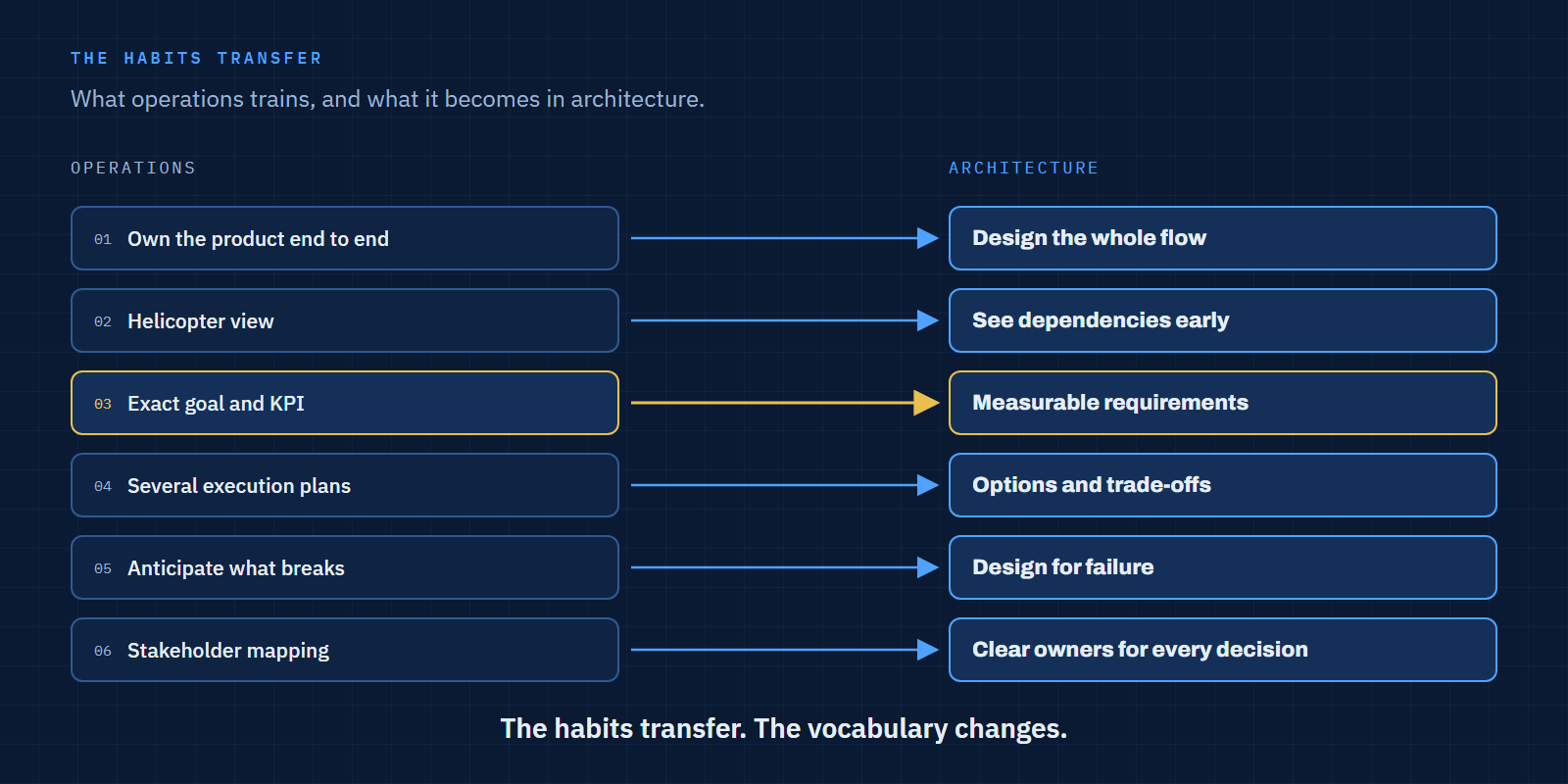
Because operations trains exactly the habits that architecture framework thinking needs, under pressure, every day.
| Habit from operations | What it becomes in architecture |
|---|---|
| Owning a product end to end, from data to the user | Designing the whole flow, not one component |
| Helicopter view across cities, teams and systems | Seeing dependencies before they break |
| Defining the exact goal and KPI before starting | Writing measurable requirements and success criteria |
| Preparing several execution plans | Comparing options and trade-offs, with a fallback |
| Anticipating what can go wrong | Designing for failure, monitoring and recovery |
| Stakeholder mapping | Knowing who owns each decision, input and system |
 Open full size
Many engineers learn these habits after years of production incidents. People from operations learn them first, because in operations a missed dependency or a vague goal shows up the next morning as a complaint, a lost booking or a city team asking why a number dropped.
How do I practise this myself?
By writing the framework down before the agent writes the code. When I built this portfolio with an AI coding agent, every feature started as a written spec with requirements, decisions and tests, and the agent worked against it. I described the process in how I built this portfolio spec-first.
The effect was the one this article argues for. Fewer back-and-forth prompts, because the agent had a precise brief. Fewer hallucinated features, because anything not in the spec was a question, not an assumption. And a codebase I can still explain, because every decision has a written reason.
The same discipline runs through my data work, such as the NYC unmet-demand pipeline: define the question and the metric first, then let the tools do the heavy lifting.
What is the takeaway?
- Building is no longer the bottleneck. Judging what was built is.
- Use a framework, not a feeling alone. A fixed set of questions catches what a quick look misses.
- Write the brief before the prompt. A precise spec saves tokens, time and rework.
- Intuition is earned. It comes from years of seeing what goes wrong, and AI can't hand it to you.
- Look beyond job titles. People who have run operations end to end often already think like architects.
FAQ
What is architecture framework thinking?
The habit of reviewing a solution against a fixed set of questions, such as reliability, security, cost and operability, before and while it is built, instead of judging it by whether it appears to work.
Is learning to code still worth it in the AI era?
Yes, enough to read and question what an AI agent produces. The bigger return now comes from knowing what to build, how parts connect and how to tell a right answer from a confident wrong one.
Does this only apply to cloud systems?
No. The same questions apply to data pipelines, internal tools, spreadsheets and dashboards. Cloud frameworks simply write them down clearly.
References
- AWS Well-Architected Framework, Amazon Web Services
- How I built this portfolio spec-first with Claude Code, on this site
- When a Metric Looks Too Good: Fixing AHT at the Source, on this site
Last updated: 30 October 2026.