- Solution Architecture
- problem-solving
- project-management
- solution-design
- geo-tech
- business-acumen
Rollout Is a Capital Allocation Problem: Placing Smart Food Lockers
Every smart locker is a physical bet. How we narrowed sites from city GMV down to a single entrance, and what a building's lunch-hour habit taught us about data.
Why is placing a smart locker a capital allocation problem?
Because every locker is a physical bet you can't undo cheaply. A software setting can be rolled back in minutes. A locker comes with hardware, a monthly rental agreement, power, a network connection and a field team to install and maintain it. Put it in the wrong place and all of that keeps costing money while delivering nothing.
GrabFood lockers are smart cabinets placed in office towers, residential buildings and campuses. A delivery partner drops the order into a compartment, and the customer opens it with a QR code or a PIN from the Grab app. The program started with a pilot in Indonesia in 2024; in Jakarta alone more than 200 lockers are now running.
The problem they solve is the last few metres. Drivers lose time looking for a safe place to leave food or waiting in a lobby, time they could spend on their next order. Customers in a meeting or busy at home don't have to rush downstairs or answer a call. Every minute saved at the handover is a minute the driver can earn with.
How did we decide where a locker should go?
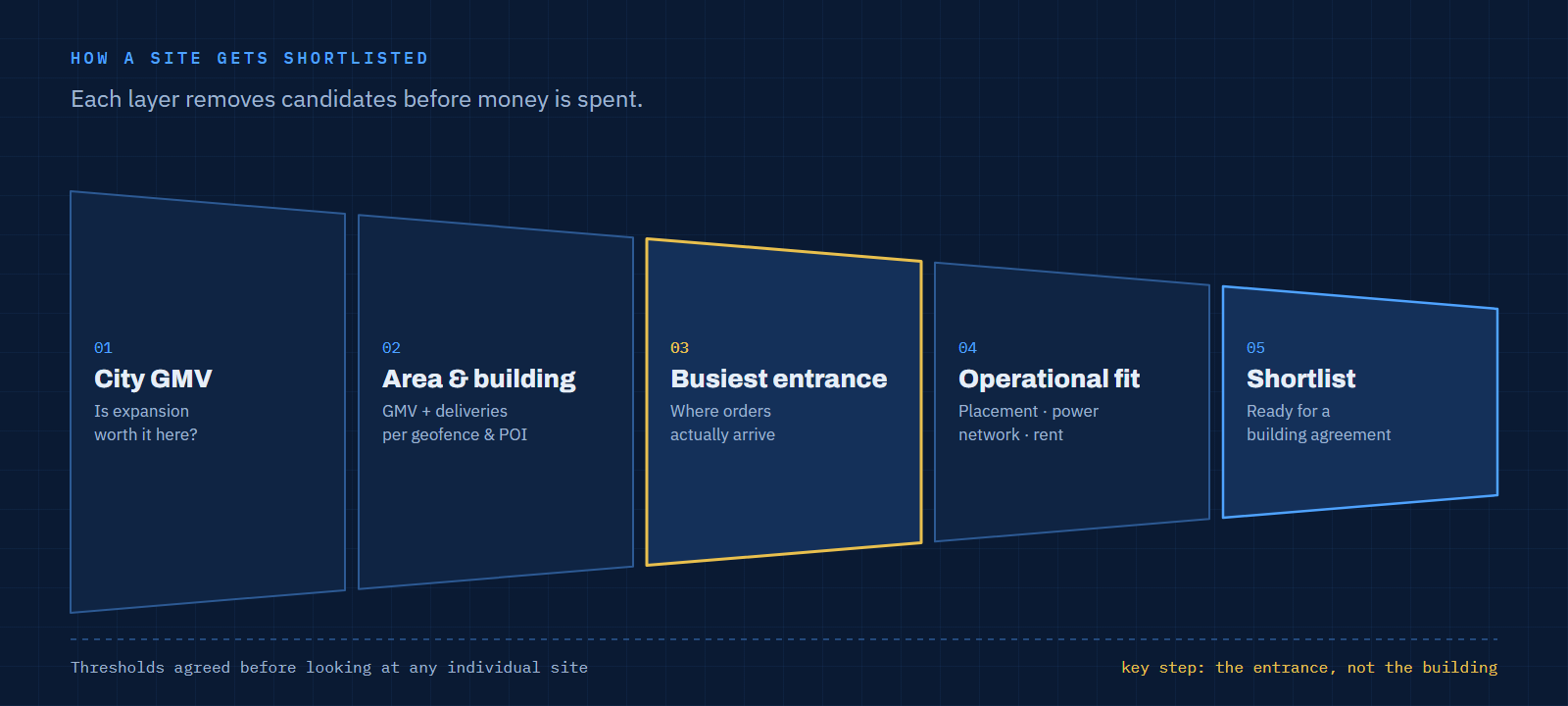
We narrowed the choice in layers, from the whole city down to a single entrance. Each layer had thresholds agreed before anyone looked at a specific site, so the shortlist wasn't driven by whichever building someone happened to like.
 Open full size
- City. Start with GMV per city to decide where expansion is worth it at all.
- Area and building. Within a city, measure GMV and delivery volume per location, using each building's geofence and its points of interest.
- Entrance. A large building has several entrances. Split its deliveries by entrance and find the one where most orders actually arrive. That spot, not the building as a whole, is the candidate.
- Operational fit. Check where the locker can physically stand (basement or open area), whether there is power and a usable internet connection, and what the monthly rent would be.
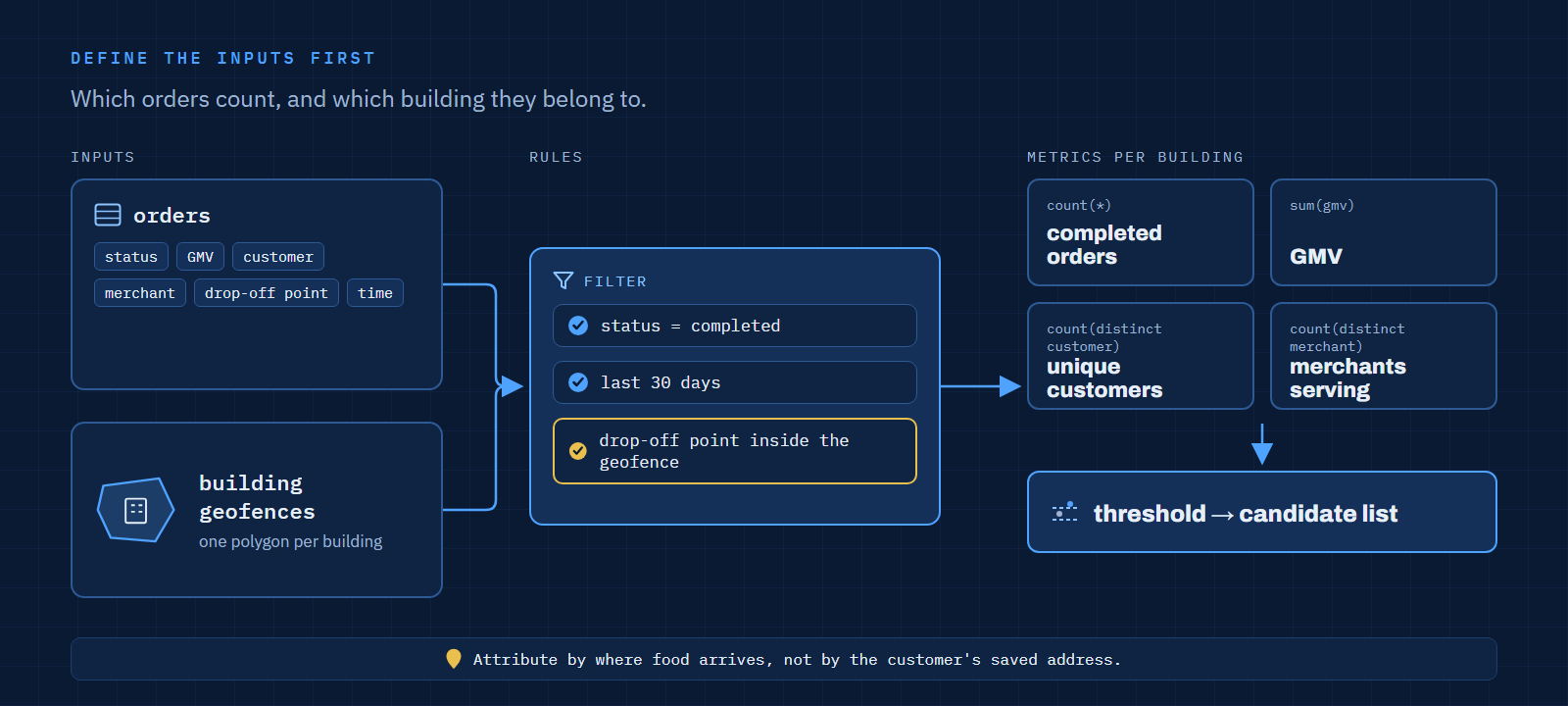
The metrics behind the first two layers look simple, but their definitions decide whether the shortlist is honest. The diagram below shows how each one is defined.
 Open full size
In SQL, simplified:
-- Simplified illustration (not production code):
-- the metrics behind each candidate building, last 30 days
select b.building_id,
       b.city,
       count(*)                      as completed_orders,   -- orders dropped off inside the building geofence
       sum(o.gmv)                    as gmv,                -- order value of those orders
       count(distinct o.customer_id) as unique_customers,
       count(distinct o.merchant_id) as merchants_serving   -- merchants that delivered here
from orders o
join building_geofences b
  on st_contains(b.geom, o.dropoff_geom)
where o.status = 'completed'
  and o.completed_at >= current_date - interval '30 days'
group by b.building_id, b.city
having count(*) >= 300                -- illustrative threshold, agreed before any site review
order by gmv desc;
Two choices in that query matter more than the numbers. Count only completed orders, so cancelled demand doesn't inflate a building. And attribute each order by where it was dropped off, not by the customer's saved address, because the locker serves the place where food actually arrives.
Then the same orders, split by entrance:
-- Simplified illustration (not production code):
-- rank each building's entrances by recent delivery drop-offs
select e.building_id,
       e.entrance_id,
       count(*) as dropoffs_30d
from deliveries d
join building_entrances e
  on st_dwithin(d.dropoff_geom::geography, e.geom::geography, 25)  -- metres
where d.dropoff_at >= current_date - interval '30 days'
group by e.building_id, e.entrance_id
order by e.building_id, dropoffs_30d desc;
The entrance level is the step that is easiest to skip. A building can rank high on GMV while its deliveries are spread across three doors, and a locker at the wrong door is almost as useless as no locker at all.
What did the data miss?
One office tower looked ideal. Strong GMV, a promising spot to install the locker, all the operational boxes ticked. We installed it. Usage didn't move at all.
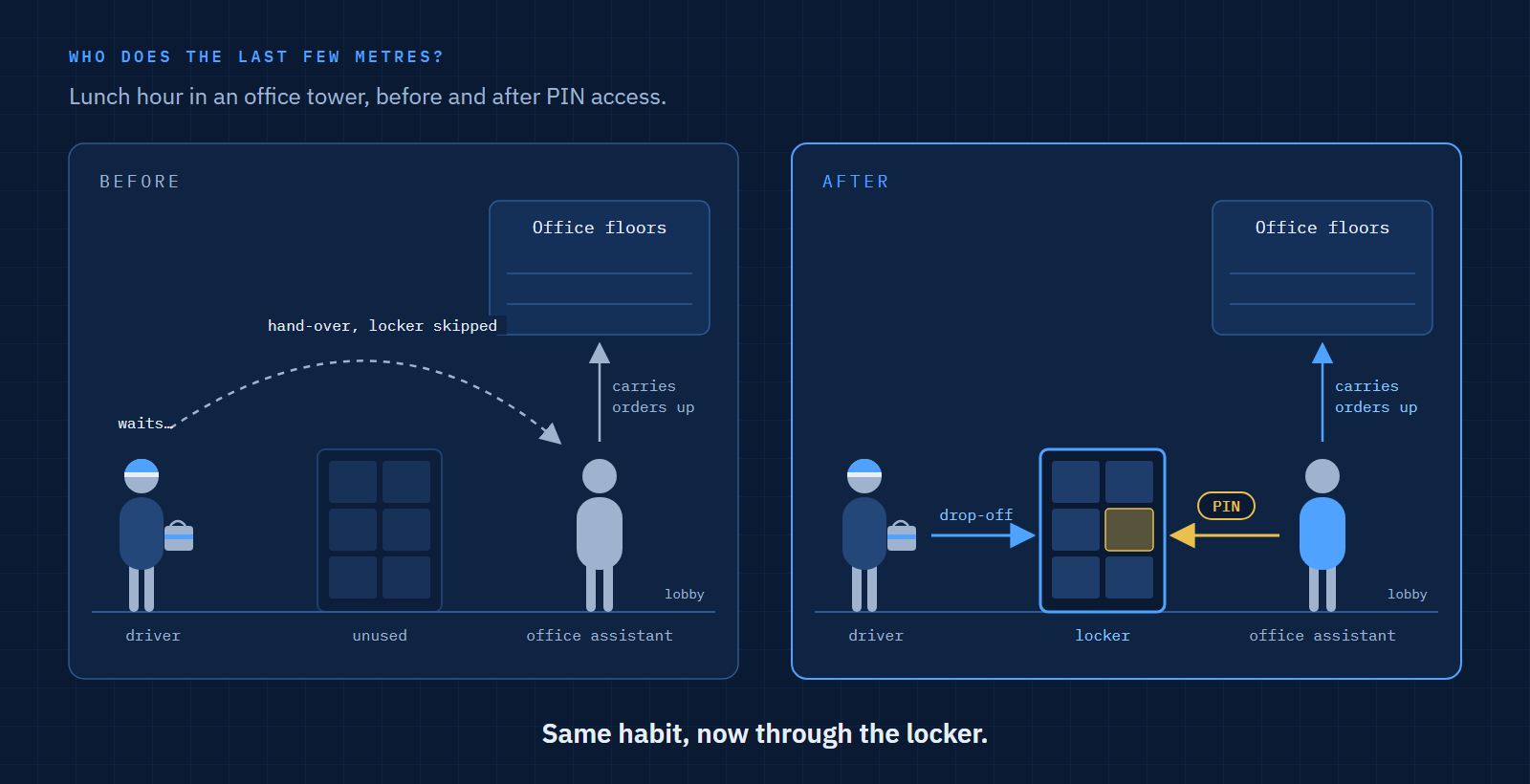
The deep dive found the reason in the building, not in the data. At lunch, each office's office assistant collected the food orders for the whole team, going up and down between the lobby and the floors. Employees never came down, so they never needed the locker. The demand we had measured was real. The person doing the last few metres was not the person we had designed for.
Every building has its own system and its own habits. GMV tells you how much demand there is. It can't tell you who walks the order upstairs.
How did we change the habit instead of moving the locker?
Moving the locker wouldn't have helped; the habit would have followed it. So the fix worked with the habit rather than against it.
- Campaigns gave employees a reason to try the locker themselves.
- PIN access let someone else open a compartment on the customer's behalf. The office assistant could keep collecting orders for the team, but now from the locker instead of from a driver waiting in the lobby.
 Open full size
Usage improved. The lesson I took from it: when the data says yes and the building says no, look at who actually handles the handover before you blame the location.
What were the hardest trade-offs?
Two came up again and again.
| Trade-off | One side | The other side |
|---|---|---|
| Speed vs. capacity | Expanding fast or hitting a monthly target quickly | Needs budget, field sales and technical support that can keep pace; without them, expansion slows down anyway |
| Price vs. placement | A building agreement with the best rental price | Often comes with a spot that users struggle to reach, or with poor network coverage |
The second one is the classic capital allocation trap: the cheapest site looks efficient on paper and wastes the whole investment if nobody uses it. A slightly more expensive spot at the busiest entrance usually pays back faster.
How do you keep a multi-city rollout on track?
With a fixed operating rhythm more than with any single analysis. My part covered most of that rhythm:
- Monitoring a usage dashboard for every deployed locker, so a flat site was spotted early instead of at quarter end.
- Ad-hoc queries to check whether a proposed location fit, on GMV and delivery volume.
- Deployment strategy and an SOP, so each city installed lockers the same way.
- Risk mitigation proposals to engineering and product, such as designs to reduce incidents at the locker.
- Regular meetings with business development, on-ground operations, the campaign team and city operations, to turn field feedback into actions; city teams cared because locker performance fed into each city's food delivery metrics.
- Regional meetings with operations teams in each country to align the deployment strategy.
The office tower was caught because of the first item. A dashboard nobody watches would have shown the same flat line for months.
What is the reusable pattern?
Any rollout of physical assets, whether lockers, charging stations, ATMs or retail kiosks, faces the same decision.
- Treat every site as an investment. Agree the thresholds before choosing locations, and judge each site against them.
- Rank down to the exact spot. Building-level demand is not enough; the entrance or corner where activity happens decides usage.
- Check who does the last few metres. The customer in your data may not be the person who handles the handover.
- Adapt the product to the habit before you move the hardware. A small feature can be cheaper than a new site.
- Pace expansion to support capacity. Growth faster than field and technical teams can follow creates sites that nobody can fix.
- Review every site after launch. Usage monitoring is what turns a bad bet into a lesson instead of a sunk cost.
FAQ
What is a GrabFood locker?
A smart cabinet in a building lobby where a delivery partner leaves a GrabFood or GrabMart order. The customer collects it with a QR code or PIN from the app, within a set time window.
How do you choose a location for a smart locker?
Start from demand at city and building level, narrow down to the entrance where most deliveries arrive, then check placement, power, network and rent. Thresholds should be agreed before looking at individual sites.
Why did usage stay flat in a high-demand building?
Because the people ordering weren't the people collecting. Office assistants picked up food for their teams at lunch, so employees never used the locker until PIN access let assistants open compartments on their behalf.
References
- GrabFood lockers: Frictionless pickups explained, Grab
- Grab FoodLocker: Smart, Contactless Food Pick-Up, Grab Cambodia
- Geospatial Product Ops: Between Maps and Business, the first article in this series
Last updated: 30 October 2026.