- Skill Set
- problem-solving
- geo-tech
- business-communication
From Ticket Queue to Root Cause: What I Could Fix and What I Could Only Escalate
Tagging every map ticket exposed two root causes. One I fixed with a handover template; the other I could only escalate. Why that split matters.
What does it mean to go from a ticket queue to a root cause?
It means treating each ticket as a data point instead of a task to close. A queue answers "what is waiting?" A root cause answers "why does this keep arriving?" In a map operations team the difference is large, because the same few problems can generate tickets for months while everyone gets better at closing them.
I covered the ticket template side in the migration post. This post is about what the tickets themselves revealed once we stopped only closing them, and about the part that did not get fixed.
How did I find the patterns?
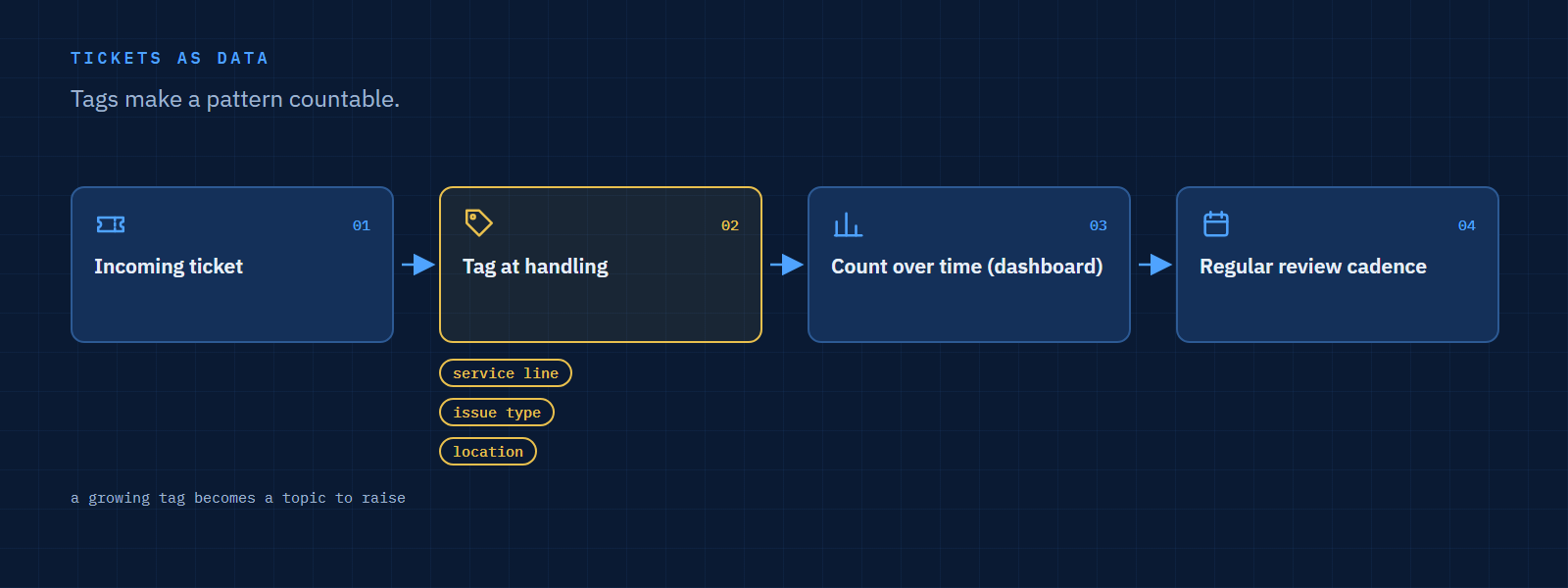
By tagging every ticket the map operations team handled and counting the tags. Each ticket went into a shared worksheet with three labels:
| Tag | What it captured | Example values |
|---|---|---|
| Service line | Which product the problem came from | delivery, rides, food |
| Issue type | What kind of map problem it was | POI, routing, fare |
| Location | Where it happened | city |
Once the tags existed, frequency was a count, and a dashboard showed it over time. The team also held a regular cadence to review the state of each project, so a tag that kept growing was something we could raise and discuss rather than something one person happened to notice.
 Open full size
Tagging is not sophisticated. Its value is that it is cheap, consistent and done at the moment the ticket is handled, which is the only time the context is fresh.
What did the tickets show?
Two different problems, with two different owners.
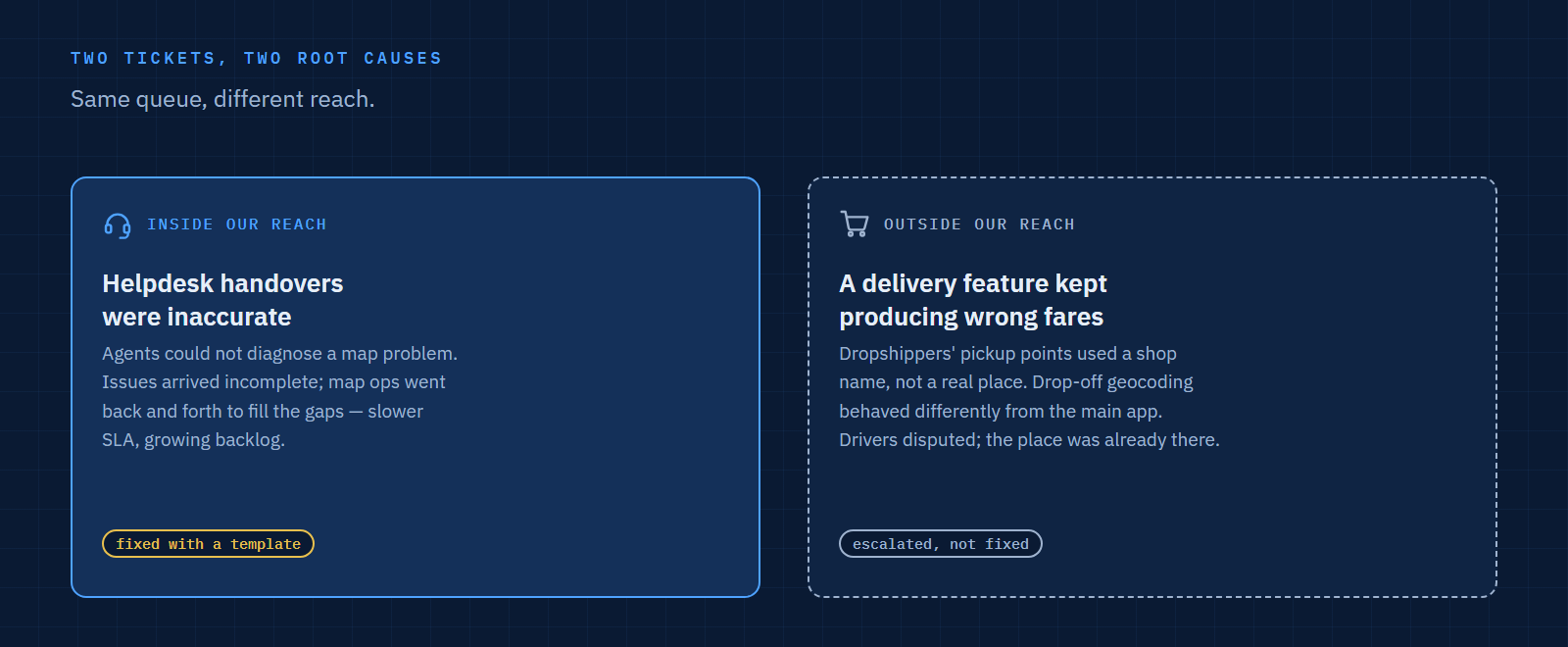
- Helpdesk handovers were inaccurate. Helpdesk agents are the first people to hear a passenger's or driver's complaint, but they are not equipped to diagnose a map problem. After some probing they forwarded the issue to map operations, often with information that was incomplete or inconsistent. Map operations then went back and forth with the agent to fill the gaps. The result was slower SLA, a growing backlog and higher load on the team.
- A product feature kept producing wrong fares and locations. A B2B delivery feature let sellers and buyers on a marketplace choose pickup and drop-off points inside the marketplace app, then use a courier. Some buyers were dropshippers. Their pickup points often could not be found, because the address was the dropshipper's shop name on the marketplace rather than a real place. For drop-off, the point selection and geocoding in the marketplace app behaved differently from the main app. Drivers filed dispute tickets, and when we checked our database the place was already there. The customer simply had not been shown it, or had not selected it.
 Open full size
What did I fix, and how?
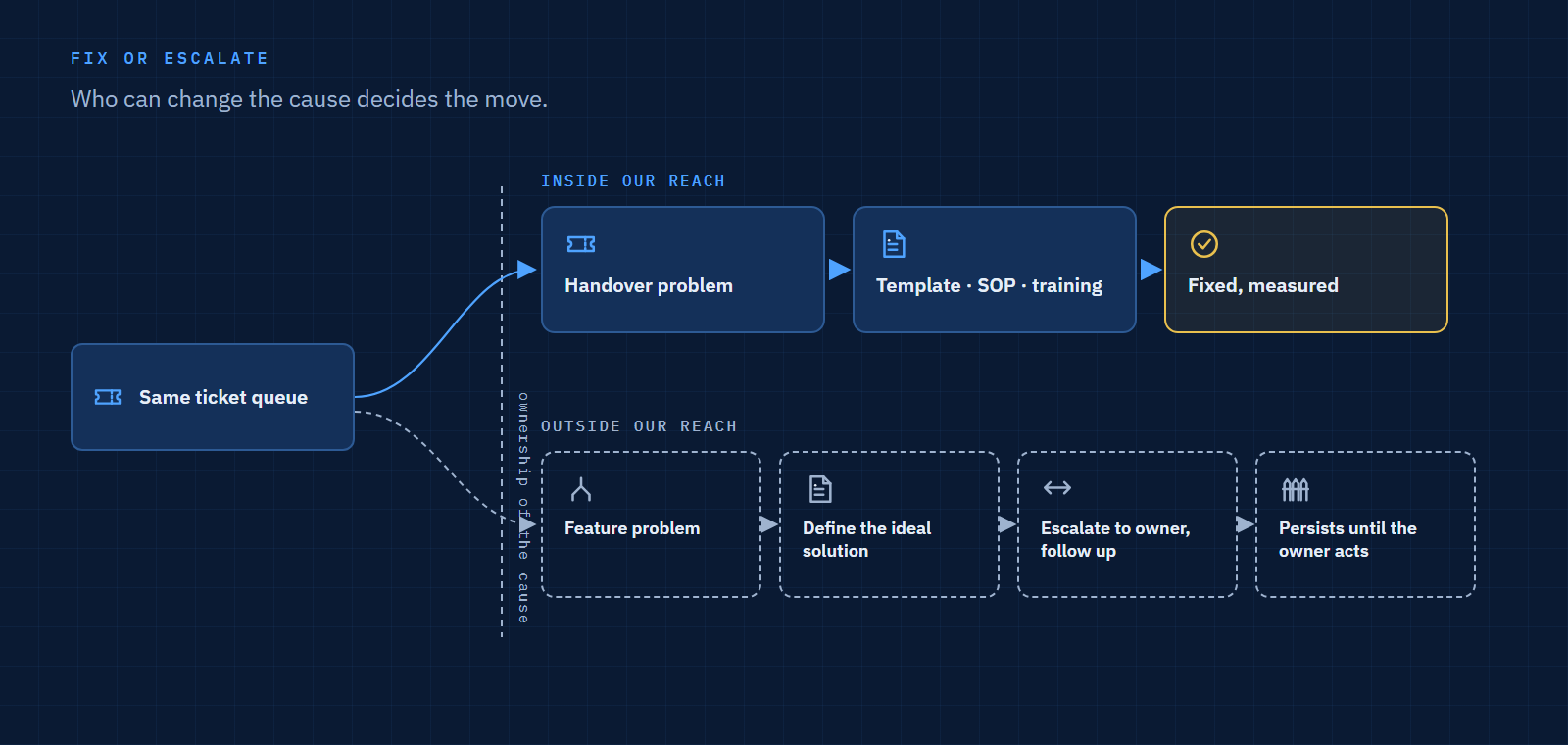
The handover problem was inside our reach, so I fixed it there. The people involved were the map operations team and the helpdesk lead.
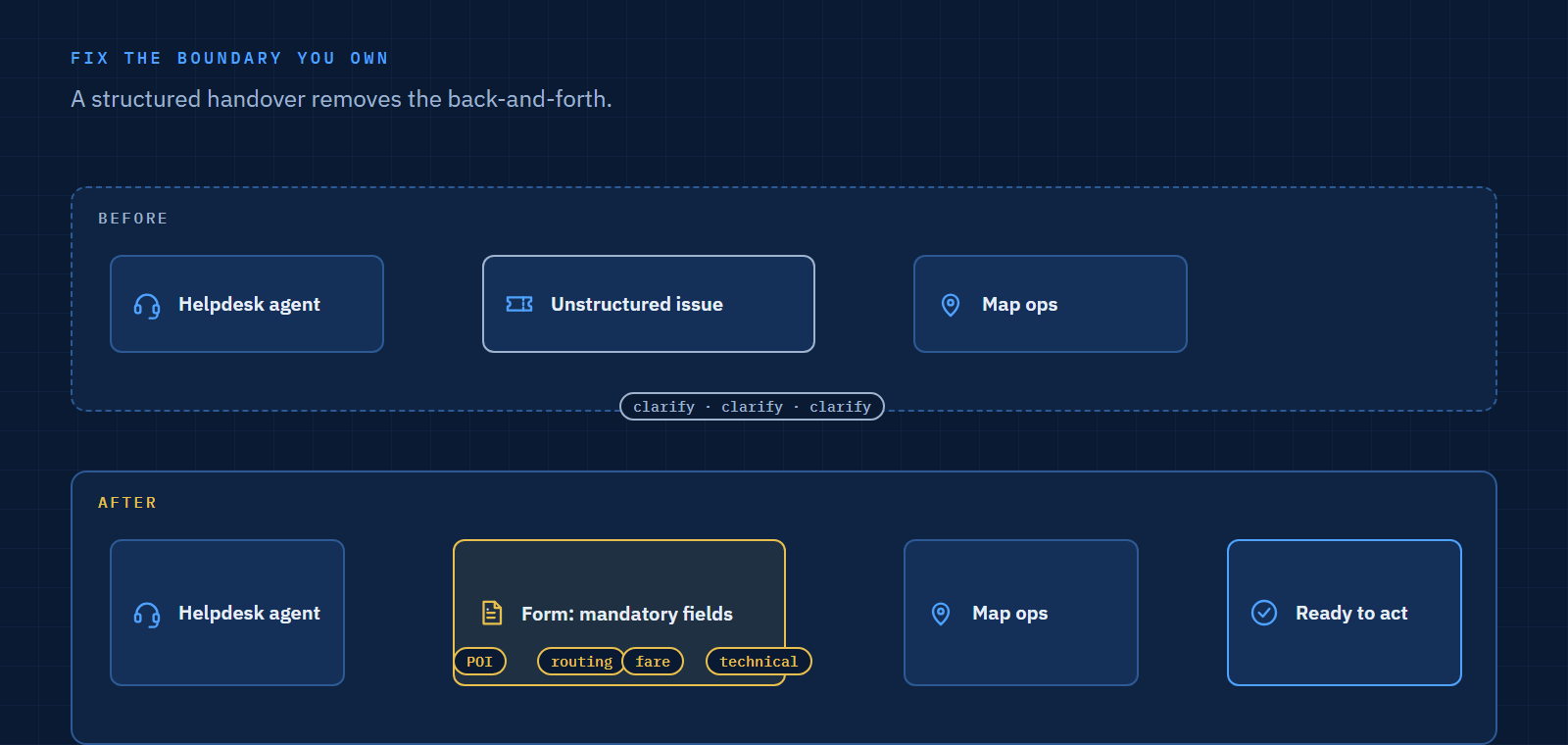
- A handover template per issue type. POI, routing, fare and general technical issues each got a form with mandatory fields. Nothing could be passed on until the key points were filled in, which structured the problem before it crossed the boundary.
- A revised SOP and joint training. Both sides learned the same workflow, so the template was not a rule one team imposed on the other.
- Regular monitoring, using the same tags, to see whether the back-and-forth was really shrinking.
 Open full size
How did I know it worked?
From the shape of the work, not from a number I can quote. Issues reached map operations in a structured form, so the back-and-forth disappeared. The team's handling throughput improved because less time went into clarifying, and the SLA stayed on time. The evidence is indirect: I am describing a change in how tickets behaved, not a before-and-after table.
What could I not fix?
The delivery feature. My suspicion was that the feature did not fully use our maps API, possibly because of how the B2B partnership was set up, so fare, distance and POI results were often wrong. It was a suspicion, and I never confirmed it, because I had no visibility into the system's configuration or architecture.
What I could do was escalate and follow up with the people who owned it: the country operations team for that service and the product manager. After several follow-up meetings, the position was clear. The problem touched a partnership and a system architecture that map operations did not control. We could define an ideal solution, but only the stakeholders could implement it. Until they did, the problem would keep appearing, and requests were not always prioritised.
What is the difference between a fix and an escalation?
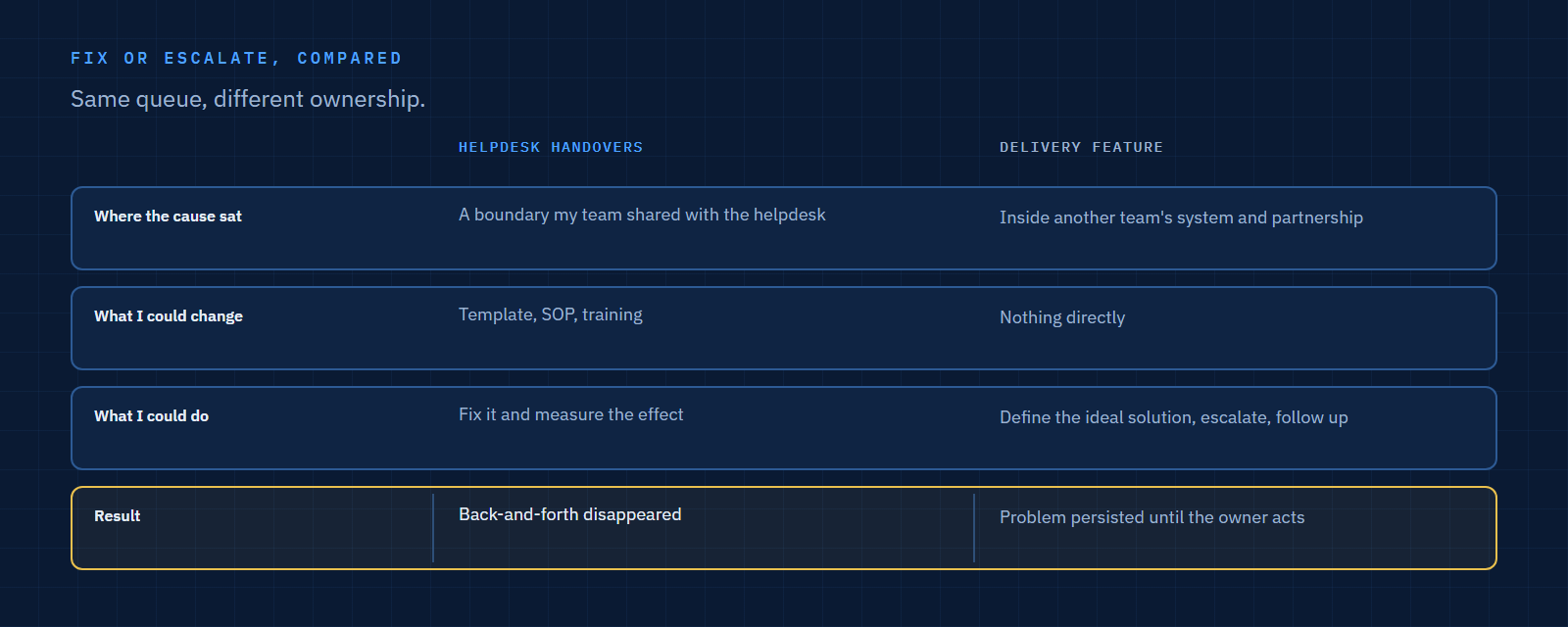
Ownership of the cause. The two problems looked similar in the queue, but they differed in one way that decided everything.
| Helpdesk handovers | Delivery feature | |
|---|---|---|
| Where the cause sat | At a boundary my team shared with the helpdesk | Inside another team's system and partnership |
| What I could change | Template, SOP, training | Nothing directly |
| What I could do | Fix it and measure the effect | Define the ideal solution, escalate, follow up |
| Result | Back-and-forth disappeared | Problem persisted until the owner acts |
 Open full size
 Open full size
Root-cause work is not "always find and fix the cause." It is finding the cause, then being honest about who can change it. Treating an escalation as a fix is how a team reports success on a problem that is still happening.
What would I do again, and what would I add?
- Tag at the moment of handling. Service line, issue type and location cost seconds and turn tickets into evidence.
- Fix the boundary you own first. A structured handover is within reach of the team that receives the ticket.
- Involve both sides in the SOP. A template one team writes alone gets worked around.
- Separate "fixed" from "escalated" in every report. Say plainly which causes you can change and which you can only raise.
- Define the ideal solution anyway. When you cannot implement it, a written design is what the owner can act on.
- Add the ticket counts to the escalation. I would bring the tag frequency to each follow-up meeting, so the cost of waiting is visible to the people who set priorities. This is what I would add, not something I can claim I did.
This is the same discipline as in fixing a too-good metric at its source and in what a polygon gap cost in revenue: the visible symptom is rarely where the fix lives.
FAQ
What is the difference between a ticket queue and a root cause?
A queue is the list of work waiting. A root cause is the reason that work keeps arriving. Closing tickets reduces the queue; removing the cause reduces the inflow.
How do you find patterns in support tickets?
Tag each ticket when it is handled, with a small fixed set of labels such as service, issue type and location, then count and review the tags regularly. A small, consistent tag set beats a detailed one that nobody fills in.
What do you do when the root cause belongs to another team?
Define the ideal solution, name the owner, escalate with evidence, and follow up on a schedule. Record clearly that the problem is escalated, not fixed, so that nobody reports it as resolved.
Why involve the helpdesk in the SOP?
Because they run the process from the other side of the handover. A workflow both sides helped design is understood by both, and the template becomes a shared tool rather than a demand.
References
- Geospatial Product Ops: Between Maps and Business, on this site
- The Hidden Data Dependencies a Map Migration Exposes, on this site
- When a Metric Looks Too Good: Fixing AHT at the Source, on this site
- When a Polygon Gap Becomes a Revenue Gap, on this site
Last updated: 20 November 2026.